Profile
Jordan Burroughs and the long season of being the match
An Olympic gold in London. Six world titles. The peculiar work of never being a surprise.
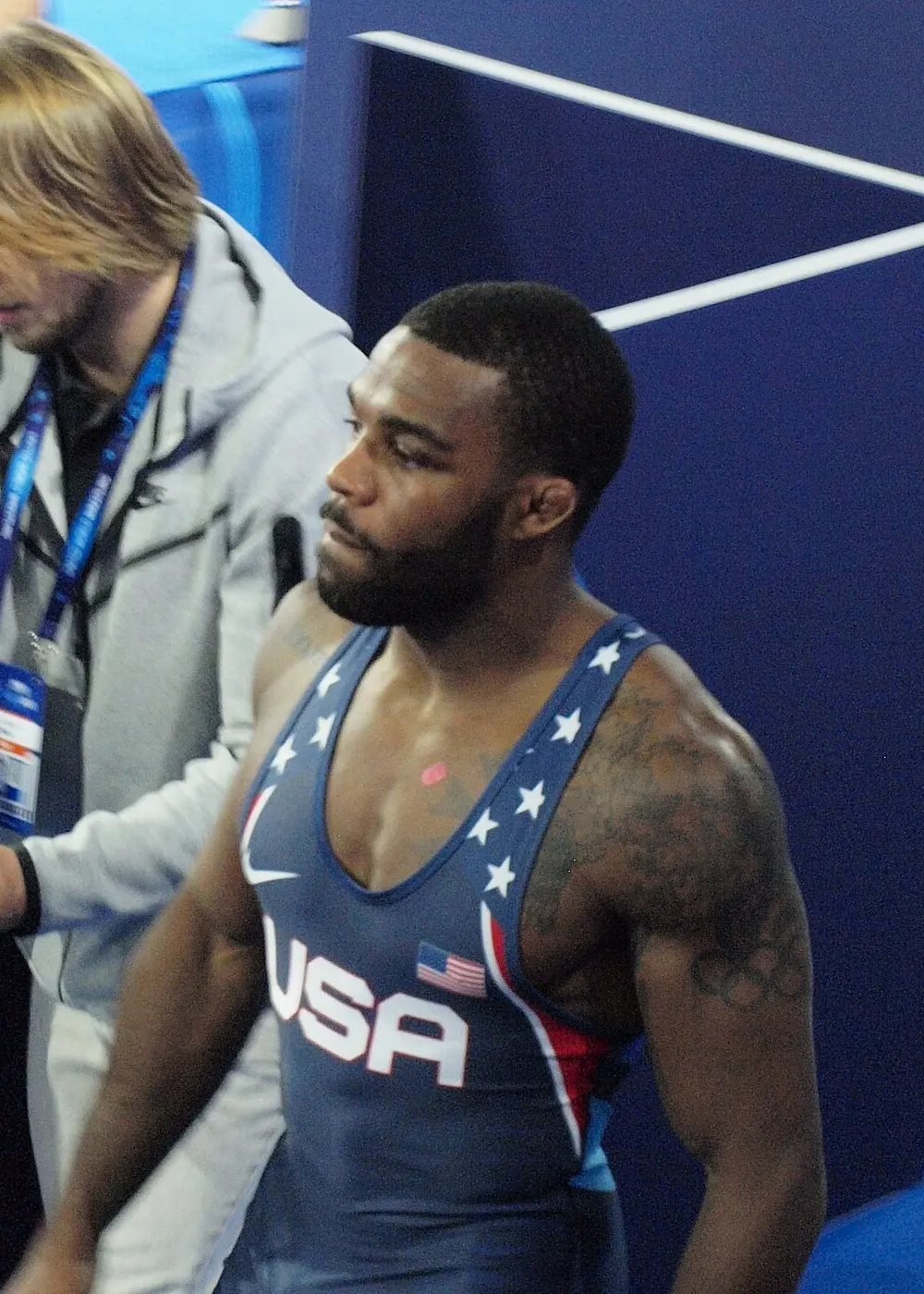
Jordan Burroughs won Olympic gold at 74 kilograms in London in 2012. Around that title he won world championships in 2011, 2013, 2015, 2017, 2021 and 2022. Six. The later two came at 79 kilograms, after the weights shifted and he followed the class instead of the nostalgia. For a long stretch, entering his half of the bracket meant solving a low attack that everyone had already studied.
That is a hard way to live a season. The blast double became a problem opponents prepared for in April. He kept scoring it, or threatening it so well that the defence made the next opening. Nebraska folkstyle under the technique. International freestyle on top. He is one of the cleanest arguments that the American room can translate, and one of the clearest examples of what the translation costs. Rio, in 2016, he finished ninth. The run of titles did not make him exempt from a bad day at the Games. The bad day belongs in the portrait.
Being expected
Being expected to win is not the same skill as winning. He had to practise both. A career is the matches after the match everyone remembers, and London is the match everyone remembers. The world titles at 79 are the correction. He did not freeze himself at the kilogram on the poster.
Kyle Snyder is the other American freestyle name from that Olympic generation that a fair paragraph has to include. Different weight. Different shape. A 2016 gold of his own at 97 kilograms, three world titles. They are not a duo. They are two answers to the same export question, which the folkstyle piece tries to ask without turning a college gym into a factory.
The shot was known. It still had to be stopped.
Any honest list of freestyle wrestlers who marked the 2010s passes through Burroughs. This magazine's interest is the craft, not the list. A low attack with a famous ending, repeated until the ending was no longer the point. The point was that you still had to deal with it. The freestyle guide will not teach you the double. A full match of his, if you can find one that is not a ten-second clip, will.
Ninth, and the titles after it
Rio is the part of the record that keeps the rest of it honest. Ninth. Not a final, not a bronze, a day when the low attack met a defence that held and the bracket moved on. Athletes with his kind of résumé are often protected from that sentence by writers who prefer the London photograph. The protection is a disservice. The world titles in 2017, 2021 and 2022 are more interesting because they exist on the far side of a public failure at the Games.
The move to 79 kilograms is the other honest detail. When the Olympic weights shifted, he did not spend the rest of the career insisting on the number from the poster. 79 is a world-championship weight. It is not an Olympic weight. Winning there, twice, is a choice about where the best wrestling was, not where the logo was. Readers who want every great freestyle career to resolve at the Games will find this unsatisfying. The sport is under no obligation to satisfy that shape.
If you are using him to understand the American pipeline, use the shot and the cost of the shot. Everyone knew it. He still had to be stopped, which is a different claim from 'he was unstoppable.' He was not. He was a problem that lasted long enough to organise other people's training. That is a rarer achievement than a single night in London, and London was already rare.